How Law Firms Can Protect Themselves From Website Cloning

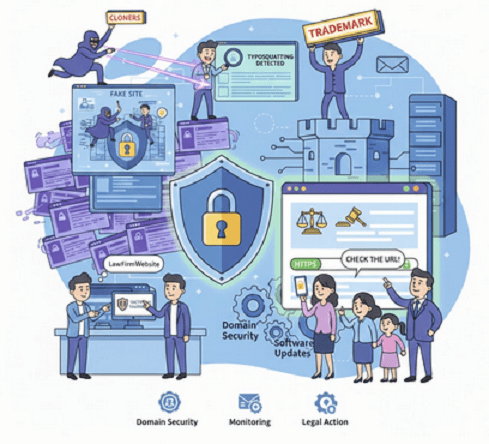
Website cloning, or “cybersquatting,” is a malicious tactic where criminals create an exact or near-exact copy of a legitimate law firm’s website. They often use a slightly altered domain name (e.g., LawFirmNamee.com instead of LawFirmName.com) to trick potential clients into revealing sensitive personal and financial information, or even to lure in job applicants for recruitment scams.

A successful cloning attack on a law firm can be devastating to its reputation and expose clients to significant risk. Protecting against this threat requires a layered, proactive strategy.

1. Fortify Your Domain and Hosting Security

The foundation of your protection starts with the core assets—your domain name and hosting environment.

  • Implement Strong Domain Security: Utilize technology that adds a layer of security to the domain name lookup process, helping to ensure that users are connecting to your actual website and not being redirected to a fraudulent clone via DNS poisoning.

  • Enable Two-Factor Authentication (2FA) for Domain Registrar: Most cloning attacks begin by compromising the registrar account to steal or redirect the domain. Two-factor authentication is a non-negotiable security measure here.

  • Use Robust Hosting Security: Choose a reputable hosting provider that offers safeguards like Distributed Denial of Service (DDoS) protection, Web Application Firewalls (WAFs), and regular malware scanning.

  • Secure Your Certificate: Ensure your site uses a valid, up-to-date Secure Sockets Layer (SSL) certificate, resulting in the HTTPS protocol. While clones can also obtain certificates, the absence of one is a clear red flag for users.

2. Monitor and Enforce Your Digital Presence

You can’t stop what you can’t see. Regular monitoring is key to early detection and takedown.

  • Establish Domain Monitoring: Use specialized services to automatically scan for domain names that are visually similar to yours (typosquatting) or use different domain endings (TLDs) like .net, .org, or country-specific ones.

  • Register Essential Variations: Proactively register the most common typos and TLD variations of your firm’s name. This acts as a protective barrier to prevent malicious actors from acquiring them first.

  • Utilize Trademark Protection and Takedown Services: If your firm’s name and logo are legally trademarked, you have a much stronger legal standing. Takedown services specialize in issuing cease and desist letters and working with domain registrars to quickly disable fraudulent sites based on intellectual property infringement.

3. Implement Strong Website Content and Code Security

Protecting the integrity of your site’s code and content is crucial.

  • Watermark and Embed Content: For highly valuable or proprietary content, consider subtle watermarking on images and embedding content (like documents) in a way that makes it difficult to simply copy and reuse.

  • Regular Software Updates: Ensure your Content Management System (CMS), themes, and plugins are always updated. Vulnerabilities in outdated software are common entry points for hackers to steal site code and databases.

  • Disable Directory Browsing: Configure your server to prevent users from browsing your file directory structure, which can expose assets that could be used for cloning.

4. Educate Your Clients and Staff

Your clients and employees are your first line of defense.

  • Staff Training: Train employees on how to spot phishing and cloning attempts and what steps to take if they encounter a suspicious website or email.

  • Client Communication: Advise clients to always check the full domain name in the address bar before entering sensitive information. Include a clear security notice on your legitimate website and in communications, reiterating that your firm will never ask for confidential information via unsecured email or third-party forms.

  • Look for Security Indicators and Exact URL: Instruct users to look for the padlock icon (indicating a valid security certificate) and to ensure the URL is exactly correct, checking for subtle spelling errors or misplaced characters.

In Summary: The Proactive Protection Checklist

CategoryActionFrequency
Domain SecurityEnable domain-level security measures and two-factor authentication.One-time/On renewal
MonitoringScan for typosquatting and visually similar domains.Monthly/Weekly
LegalRegister trademarks; have a formal takedown plan ready.One-time/As needed
Website MaintenanceUpdate CMS, themes, and plugins.Weekly/Bi-weekly
EducationTrain staff; post client security advisories.Quarterly/As needed
 

Awareness is your strongest defense.   

Contact us if you’d like more information on how cyber intelligence can help you locate scammers. 

Please share this guide with friends and colleagues.

Facebook
Twitter
LinkedIn
Reddit

Do You Suspect You Are

A Victim Of An Online Scam?

How Law Firms Can Protect Themselves From Website Cloning

Cloned Firms Alerts & Scam Awareness

The Legal Reality: "Are Clone Scammers Ever Caught?"

The Legal Reality – Are Clone Scammers Ever Caught?

A new breed of outlaw has emerged: the clone scammer. Whether they are using AI to mimic a CEO’s voice, deepfaking a relative’s face on a video call, or “cloning” credit cards and EBT data to drain accounts, these criminals feel untouchable behind their screens.

Get in touch today and receive a free phone consultation.

author avatar
Terry Lawrence

Leave a Reply

Your email address will not be published. Required fields are marked *