
🛡
Scam Prevention Guide
How to Check if a Law Firm Website Is Real or a Cloned Scam
Published: March 7, 2026
Contents
Full Guide
How to Check if a Lawyer's Website Is Real or a Cloned Scam
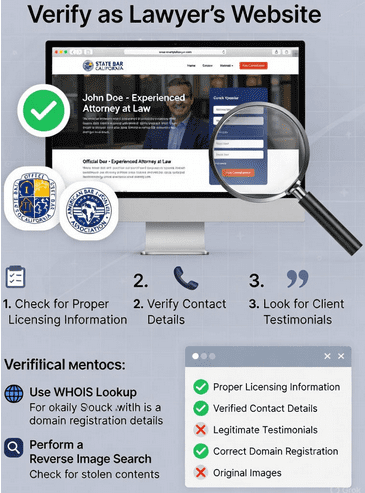
Cloned law firm sites are especially common in personal injury, debt collection, immigration, and cryptocurrency recovery scams. Fortunately, with a few systematic checks, you can spot most fakes in minutes. Here's a step-by-step guide.
Verify Attorneys Are Licensed and Affiliated with the Firm
- Every U.S. lawyer must be licensed by their state bar (or the relevant regulatory body in other countries).
- Go directly to the official state bar website (never click a link from the suspicious site) and search for each lawyer listed.
- Example: For California → calbar.ca.gov, Texas → texasbar.com, New York → nysba.org.
- Check: Is the lawyer in good standing? Does their listed firm/address match the website you're viewing?
- Red flag: The bar profile shows a different firm, or the lawyer doesn't exist.
Cross-Check the Firm's Contact Information with Official Sources
- Copy the firm's name and phone number/email, then search them independently on Google or the state bar directory.
- Call the phone number listed on the official state bar profile (not the website) and ask if the site you're looking at is theirs.
- Scammers often change only the contact info on cloned sites. If the real firm says "That's not our website," it's a scam.
Inspect the Website URL and Domain
- Legitimate firms usually have clean, professional domains (e.g., smithlawfirm.com, joneslawyers.com).
- Common scam tricks:
- Typo-squatting: smithh-lawfirm.com (extra letter), smithlawfirm.co (not .com), smith-lawfirm.net.
- Subdomains: reallawfirm.clientsite.net.
- Suspicious TLDs: .xyz, .top, .club, .info.
- Use WHOIS lookup (whois.icann.org or whois.com) to see when the domain was registered.
- A domain registered 2 weeks ago is highly suspicious.
Look for Poor Quality or Inconsistencies on the Site Itself
- Broken links, placeholder text ("Lorem ipsum"), low-resolution stolen photos, or generic stock images.
- Outdated content (e.g., blog posts stopping years ago on the "real" site but copied statically).
- Grammar/spelling errors (surprisingly common on rushed clones).
- Missing or vague physical address (or a fake one that Google Maps shows as a parking lot/residential home).
Search for the Exact Website or Images in Reverse
- Google a unique sentence from the site's "About Us" page in quotes (e.g., "John Doe has been practicing law for 25 years in downtown Chicago").
- If the exact text appears on a different domain that's older/verified, you've found the real site.
- Right-click attorney photos → "Search Google for image.
- Photos often stolen from the legitimate firm's site, LinkedIn, or bar profiles.
Examine Security and Technical Details
- Does the site use HTTPS with a valid certificate? (Most do now, but lack of it is a red flag.)
- Hover over links (especially "Contact Us" forms) to see where they really go.
Test by Contacting Them the Safe Way
- Never send money or sensitive info right away.
- Insist on an in-person or video consultation (scammers avoid this).
- Ask detailed questions only the real lawyer would know (e.g., recent local cases).
Quick Checklist (Copy-Paste This When Evaluating a Site)
| Check | How to Do It | Real Firm? | Likely Scam? |
|---|---|---|---|
| State Bar Verification | Search lawyers on official bar site |  Matches Matches |  No match/missing No match/missing |
| Domain Age (WHOIS) | >3–5 years old | | <1 year |
| URL Spelling | Exact firm name, .com/.law usual | | Typos/subdomain |
| Contact Info Matches Bar | Call bar-listed number | | Different |
| Reverse Image/Text Search | Photos/text appear on older verified site | (if yours is older) | (if another is older) |
| Reviews & History | Years of presence on Google, etc. | | None/new |
If even one major item fails, walk away. Report suspicious sites to the real firm (they'll appreciate the heads-up).
Staying vigilant takes just 5–10 minutes and can save you thousands of dollars and immense stress. When in doubt, start your lawyer search through your state bar's official referral service instead of random Google ads or unsolicited messages.
Please share this guide with friends and colleagues.