The Psychology of Why Our Brains Fall for the Clone
Published: March 8, 2026 · Updated: March 9, 2026
Contents
Full Guide
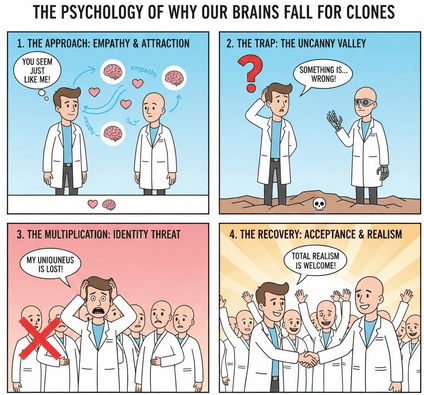
The Bridge of Empathy: Why We "Fall"
The Liking Response: As an object becomes more human-like, our affinity for it increases. We project "personhood" onto it, assuming a shared internal life.
The Face-Identity Link: Humans operate on a one-to-one correspondence between a face and a unique identity. When we see a "clone" (a perfect replica), our brain initially grants it the same social status and empathy we would give a real person because the visual hardware says: "This is one of us."
The Trap: The Uncanny Valley
The term, coined by Masahiro Mori in 1970, describes the point where a replica becomes almost perfect but remains slightly "off."
At this stage, our response plunges into a "valley" of eeriness. Recent research suggests this happens because of a Perceptual Mismatch. Your brain’s visual cortex sees a human, but your parietal cortex (which processes movement) detects something mechanical. When appearance and motion do not gibe, the brain "misfires," leading to a sense of vertigo or unease.
The "Clone Devaluation" Effect
Beyond the Uncanny Valley lies a specific psychological quirk discovered by researchers at Kyushu University: the Clone Devaluation Effect.
Studies show that as the number of identical faces increases (e.g., seeing six people with the exact same face), our sense of "eeriness" rises. This isn't just about the "creep factor" of robots; it’s a threat to our Identity Essence.
The Impostor Fallacy: We possess an intuition that every human has a unique, unobservable "essence."
The Threat to Uniqueness: Seeing a clone violates the principle of individuality. It triggers a subconscious fear that if someone else can be exactly like us, then our own identity is replaceable and, therefore, meaningless.