Top Warning Signs of a Fake Law Firm Website
Published: March 9, 2026 · Updated: March 9, 2026
Contents
Full Guide
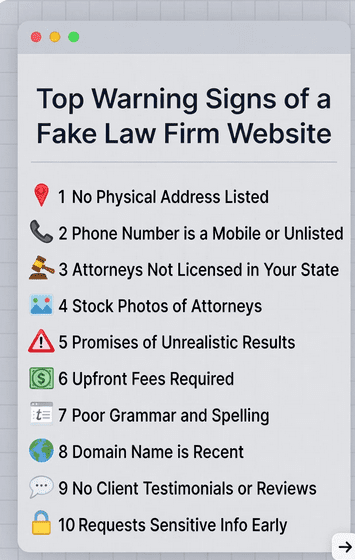
No Physical Address or a Fake One
Real law firms proudly display their office address and often include photos of the building. Fake sites either:
- Omit any address at all
- Use a fake or “virtual office” address.
- List an address that Google Street View shows is a parking lot, vacant building, or private home.
Quick check: Copy the address into Google Maps. If it doesn’t match a real law office, walk away.
Phone Number Issues
- The number is a mobile phone or VoIP (internet) number instead of a landline.
- The area code doesn’t match the city they claim to be in.
- The number goes straight to voicemail with a generic greeting (“You’ve reached Attorney John Smith…”).
- Reverse phone lookup shows the number registered to an individual or unrelated business.
Attorneys Not Licensed or Using Stolen Identities
- The listed attorneys are not found in the state bar directory.
- Photos and bios are stolen from real lawyers in another state or country.
- The attorney has a bar number that doesn’t exist or belongs to someone else.
Always verify: Go to your state bar website and search the attorney’s name and bar number.
Stock Photos and Generic Content
- Headshots are obvious stock photos (reverse-image search with Google often reveals the same photo used on dozens of scam sites).
- The website text is vague, full of legal buzzwords, but lacks specific case results or practice-area depth.
- “Our Team” page shows the exact same people used on unrelated scam sites.
Unrealistic Guarantees or Pressure Tactics
Legitimate lawyers never guarantee results. Watch for phrases like:
- “100% success rate”.
- “We win every case.”
- “Money-back guarantee if we lose”.
- Urgent language: “Act now before your statute of limitations expires in 24 hours!”
Upfront Fees for Services That Shouldn’t Require Them
Common in debt settlement and debt collection scams:
- Demanding large retainers via wire transfer, Bitcoin, or gift cards before any work is done
- Asking for payment to “stop a lawsuit” or “remove a warrant” that doesn’t actually exist
Real lawyers usually offer free initial consultations and only collect payment after a signed retainer agreement.
Poor Grammar, Spelling, and Design Flaws
- Typos and broken English throughout the site.
- Outdated design (looks like it was built in 2005).
- Broken links, placeholder “Lorem ipsum” text, or pages “under construction” for years.
Domain and Hosting Red Flags
- The domain was registered very recently (check with whois.domaintools.com).
- The domain uses odd extensions (.co, .lawyer, .attorney, .club, .xyz) instead of .com or state-specific domains.
- The website is hosted in Russia, China, or other countries frequently associated with cybercrime.
No Real Client Reviews or Fake Reviews
- Zero presence on review websites.
- Reviews that all appear on the same day with identical wording.
- Reviews on the firm’s own site that cannot be found anywhere else.
Contact Forms That Ask for Sensitive Information Immediately
Fake sites often ask for:
- Social Security number
- Bank account details
- Copies of ID or passport …before you’ve even spoken to anyone. Real firms never do this on a first contact form.
Bonus Red Flag: They Contact You First
Legitimate law firms almost never cold-call or cold-email potential clients (especially about debt, accidents, or immigration). If someone claiming to be a lawyer reaches out to you unsolicited, it’s almost certainly a scam.
Quick 60-Second Verification Checklist
- Look up the attorney on the official state bar website.
- Google the exact firm name + “scam” or “fraud”.
- Verify the address on Google Maps Street View
- Check when the domain was registered.
- Call the state bar consumer protection hotline if something feels off.
Protect yourself: If something feels too good to be true, or if they pressure you to pay immediately, trust your gut and walk away.
Real lawyers have nothing to hide.