A law firm’s website is its virtual front door. Scammers , however, are increasingly using sophisticated, fake websites to trick unsuspecting individuals seeking legal help. Falling for one of these can lead to identity theft, financial loss, and severe legal risk.
Knowing how to quickly scrutinize a site is essential for protecting yourself. Here is a guide on how to spot a fake law firm website in minutes.
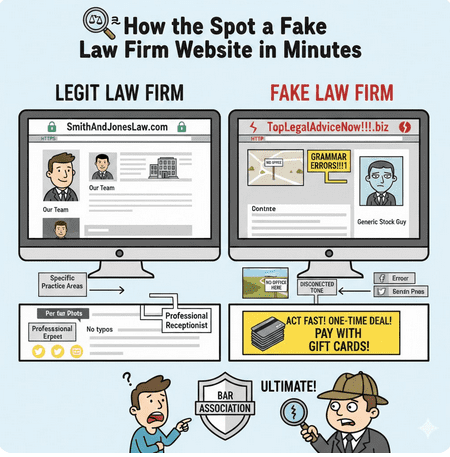
1. Scrutinize the Domain and URL
The website’s address, or URL, is the very first clue.
Look at the Domain Name: Authentic law firms almost always use a domain name that closely matches their actual name (e.g., SmithAndJonesLaw.com). Be wary of domains that are overly generic (e.g., TopLegalAdviceNow.net), contain excessive numbers or dashes (e.g., https://www.google.com/search?q=SmithJones-Law-321.com), or use a non-standard extension like .biz, .info, or .co when .com or a country-specific extension is expected.
Check for HTTPS: The URL should begin with https://, not just http://. The “s” stands for secure and indicates that the site is using encryption. While not a guarantee of legitimacy, a modern business website without basic security is a major red flag.
2. Verify Attorney Credentials and Contact Information
A legitimate law firm is transparent about the lawyers who work there and how to reach them.
Cross-Reference Attorney Names: Go to the site’s “Our Team” or “Attorneys” page. Note the names. You should be able to independently verify that these individuals are licensed attorneys in the stated jurisdiction. Search the name, their state/bar association, and their claimed specialty. A fake site might list real lawyers to appear credible, but a quick search will reveal the lawyers work elsewhere or the firm name is entirely fabricated.
Check the Physical Address: A professional law firm has a verifiable physical office. Take the address listed on the website and search for it on a map service. Does it resolve to an actual commercial building, or is it a residential address, a vacant lot, or a generic co-working space?
Examine the Phone Number: Call the listed number. Does a professional receptionist or automated system answer with the firm’s actual name? Scammers often use disconnected numbers, burner phones, or generic voicemail.
3. Review the Quality of Content and Design
Fake sites are often built quickly, leading to tell-tale signs of poor quality.
Typographical Errors and Poor Grammar: Professional legal documents and websites are meticulously edited. If the site is riddled with spelling mistakes, awkward phrasing, or grammatical errors—especially in prominent sections like the homepage or practice areas—it is a strong indication that it was not created by professionals.
Stock Photos: Be suspicious of generic, overly perfect, or poorly resolved images. If the team photos look like they were pulled directly from a stock photo library without any personalization, it’s a concern. You can often right-click (or use a reverse image search tool) to see if the image appears on dozens of unrelated websites.
Lack of Specificity: Legitimate firms provide details about their history, specific case results (often anonymized or generalized), and niche practice areas. Fake sites often use vague, high-level boilerplate text without providing concrete examples or credentials.
4. Look for Trust Indicators and Red Flags
A legitimate business builds trust; a fake site will exhibit behaviors designed to rush or scare you.
The “Hurry Up” Factor: Does the site or subsequent correspondence pressure you to send money immediately, use non-traditional payment methods (like gift cards or cryptocurrency), or claim a “once-in-a-lifetime settlement” that must be acted upon within hours? Reputable law firms do not operate this way.
Missing or Empty Pages: Check for essential pages like “Privacy Policy,” “Terms of Use,” and “Disclaimer.” If these pages are missing, lead to an error, or contain only generic placeholder text, the site is likely incomplete and untrustworthy.
Social Media Icons: While not every firm uses social media, if they do, the links should lead to active, professional accounts that consistently use the firm’s name and branding, not generic or inactive profiles.
Your Safety Net: The Bar Association
The single most effective tool you have is your local or state Bar Association website. Every licensed attorney in a given jurisdiction is registered with their governing bar.
If a law firm or attorney is claiming to operate in a certain state, use that state’s bar association online directory to look up the lawyer’s name and the firm’s name. If they are not listed, they are likely a scammer.
By taking a minute to apply these critical checks, you can quickly filter out the fraudulent websites and ensure you are working with a legitimate and licensed legal professional.
Awareness is your strongest defense.
Contact us if you’d like more information on how cyber intelligence can help you locate scammers.
Please share this guide with friends and colleagues.