The “clone”—whether it’s a synthetic voice, a generated image, or a hijacked profile—is becoming harder to detect. However, even the most advanced AI usually leaves behind “digital artifacts.”
You don’t need a degree in computer science to protect yourself. You just need to run this 5-second mental checklist the moment something feels “off.”
1. The “Glitch” Test (Visuals)
If you are looking at a photo or a video call, look for the edges. AI often struggles with where one object ends and another begins.
The Check: Look at the ears, the hairline, and the glasses.
The Tell: Do the earrings match? Does the hair blur into the background like a smudge? Are the glasses merging into the skin? If the edges are “fuzzy” or nonsensical, it’s a clone.
2. The Blink and Breath (Video)
Early-stage video clones often forget the basic biological rhythms of a human being.
The Check: Watch the eyes and the chest.
The Tell: Does the person blink naturally, or do their eyes remain fixed? Is there a rhythmic rise and fall of the chest for breath? Clones often look like “living statues”—perfectly rendered but eerily still.
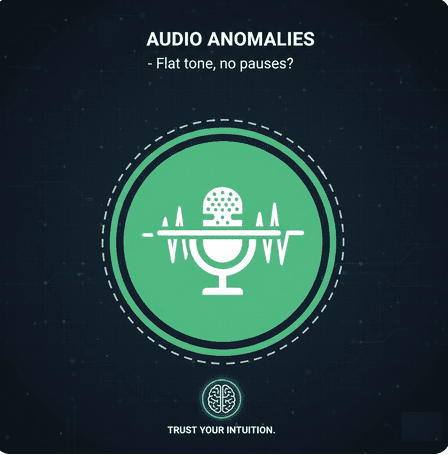
3. The Robotic Cadence (Audio)
Voice cloning is the tool of choice for “emergency” phone scams. While the tone might sound exactly like your friend or CEO, the rhythm is usually wrong.
The Check: Listen for the pauses.
The Tell: Human speech is messy; we use “umms,” we trail off, and we change pitch based on emotion. A clone often has a “flat” urgency—a consistent, monotonous pace that doesn’t quite react to your interruptions.
4. The Lighting Logic (Environment)
AI generates subjects and backgrounds separately, often leading to a mismatch in physics.
The Check: Follow the light source.
The Tell: If the light is hitting the person’s face from the left, but the shadows in the background are falling to the left as well, the scene is a composite. Shadows don’t lie.
5. The “Pattern” Interruption (The Ultimate Fail-Safe)
If you suspect you are talking to a digital clone, the fastest way to break it is to force it to go “off-script.”
The Check: Ask a nonsensical or personal question.
The Tell: “What did we have for lunch three days ago?” or “Can you hold up your hand and wiggle three fingers?” A clone or a pre-recorded deepfake will often ignore the prompt, glitch out, or give a generic “I don’t have time for that” response.
The Golden Rule: If your gut says it’s a clone, it probably is. Technology moves fast, but human intuition is tuned to millions of years of “real” interaction.
Awareness is your strongest defense.
Contact us if you’d like more information on how cyber intelligence can help you locate scammers.
Please share this guide with friends and colleagues.