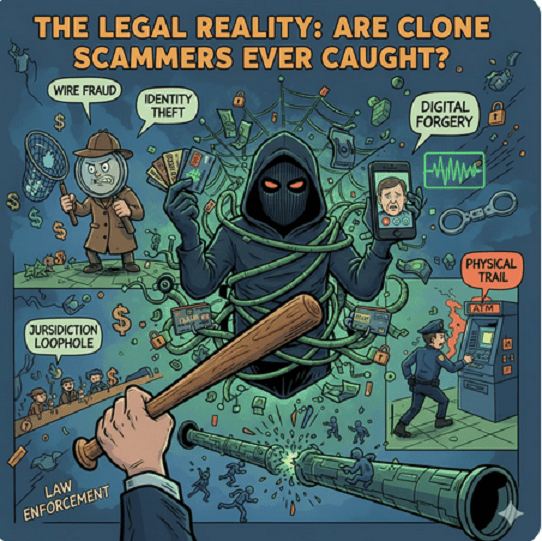
A new mega-outlaw has emerged – the clone scammer. Whether they are using AI to mimic a CEO’s voice, deepfaking a relative’s face on a video call, or “cloning” credit cards and EBT data to drain accounts, these criminals feel untouchable behind their screens.
For victims, the question isn’t just about recovering lost funds—it’s about justice. Do these people actually go to jail? The answer is a complex mix of “yes,” “sometimes,” and “it’s complicated.”
The Odds: A Statistical Reality Check
While law enforcement agencies like the FBI and Interpol have ramped up their specialized cybercrime units, the sheer volume of attacks is staggering.
The Reporting Gap: According to federal crime reports, annual losses from digital fraud are into the billion of dollars, yet only a small fraction of these cases result in arrests.
The 1% Problem: Legal experts and digital forensic analysts estimate that fewer than 1% to 5% of online scammers are ever successfully prosecuted.
The primary reason? Jurisdiction. Most high-level “cloning” operations—particularly those using AI voice and video—originate from countries that do not have extradition treaties with the U.S. or Europe, making it difficult for local police to cross borders.
How They Actually Get Caught
Despite the grim statistics, scammers are being caught. When the law wins, it is usually through one of three avenues:
1. “Cloned” Physical Devices
Criminals who use “cloned” cards (re-encoding magnetic strips with stolen data) are the most likely to face handcuffs. Because they must physically interact with ATMs or Point-of-Sale systems, they leave a physical trail for local police.
Case Study: In a major 2024 bust, the U.S. Secret Service arrested three individuals in California for stealing $22 million in benefits using cloned cards. They were caught through a 14-month operation involving physical surveillance and ATM data tracking.
2. The “Insider” or Local Actor
AI-cloning is often more effective when the scammer has personal details about the victim. This sometimes leads back to people within the victim’s own country or social circle, who are much easier to arrest.
For example, in one case in the USA, an athletics director was caught after using AI to clone his principal’s voice to frame him for making racist remarks. Investigators traced the digital fingerprints of the audio file back to his personal devices.
3. Large-Scale Infrastructure Busts
Law enforcement often ignores the small fish to go after the platforms that facilitate the scams. By cutting off the tools scammers use—such as telecom providers that allow mass robocalls—the law can dismantle entire networks at once.
The Prosecution Pipeline
If a scammer is caught, the legal consequences are severe. Because “cloning” involves multiple layers of illegality, prosecutors often stack charges: