
Verify if a Financial Firm Has Been Cloned or Impersonated
Verify a Cloned Firm
Verify if a firm has been cloned or impersonated. Financial scams have become increasingly sophisticated, and one of the most dangerous forms is firm cloning — when fraudsters impersonate a legitimate financial institution to deceive clients into handing over money, account information, or identity credentials. With digital banking pervasive and remote investing now mainstream, knowing how to detect a cloned or impersonated financial firm is crucial for safeguarding your finances.
Let’s explore what financial firm cloning is, why it happens, common red flags, and, most importantly, reliable steps you can take to verify whether a firm is legitimate or a counterfeit posing as the real thing.
What is a Cloned or Impersonated Financial Firm?
A cloned financial firm is a scam where fraudsters copy the identity of an existing reputable financial institution — including its name, logo, licensing information, website, phone numbers, and even staff names — to create a convincing façade.
Unlike fake firms that are wholly fabricated, cloned firms hide behind the reputation of a real business. The fraudster’s goal is to trick you into believing you’re interacting with the genuine company so you’ll disclose sensitive information, deposit funds, or authorize transactions.
Common cloning targets include:
Investment advisory firms
Brokerage firms
Banks and credit unions
Retirement planning firms
Insurance providers
Cryptocurrency exchanges
Why Cloned Firms Are Dangerous
Cloned firms are especially dangerous because they leverage trust. When a scammer pretends to be a known institution, you might assume that regulatory oversight and consumer protections apply — and that assumption can be costly.
Victims may suffer:
Loss of invested funds
Identity theft
Unauthorized account access
Long-term credit damage
Because the fake entity uses the real firm’s details, traditional internet searches can even produce results that look legitimate.
Typical Cloning Scenarios
Cloning may show up in several ways, including:
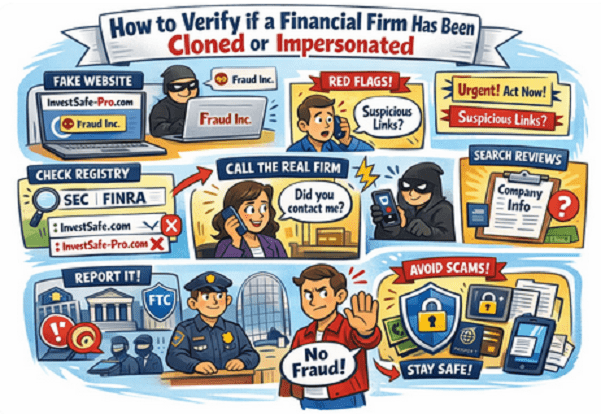
1. Fake Websites
Scammers build a look-alike website with a similar domain such as:
Real: investsecure.com
Fake: investsecure-invest.com or investsecure-us.com
These sites may mimic design, content, and even customer portals.
2. Fraudulent Emails or Texts
Emails that seem to come from the real firm but have slight variations in sender addresses or include misspellings and suspicious links.
3. Social Media Profiles
Fake social media pages using the company’s logo and branding to communicate and solicit funds.
4. Phone Calls
Fraudulent representatives calling you claiming to be from a financial institution — sometimes with spoofed phone numbers that appear legitimate on caller ID.
5. Investment Offers
Promotions for high-yield investments or retirement rollovers that reference the name of a legitimate firm but lead you to transfer funds to fraudsters.
Red Flags: Warning Signs of Impersonation
Before diving into verification steps, here are common red flags that should immediately raise suspicion:
1. Unsolicited Contact
Unexpected phone calls, texts, or emails from someone claiming to be from a firm you didn’t initiate contact with.
2. Pressure Tactics
Any sense of urgency — “act now,” “limited time offer,” or warnings that your account will be closed unless you act immediately.
3. Errors and Inconsistencies
Poor spelling or grammar, unusual formatting, or inconsistent logos in emails or websites.
4. Suspicious URLs
Web addresses that don’t match the firm’s official domain exactly, include extra words, or use uncommon domain extensions.
5. Requests for Sensitive Information
Legitimate financial firms generally won’t ask for passwords, PINs, Social Security numbers, or secure authentication codes via email or text.
How to Verify a Financial Firm
The good news is that there are clear, practical steps you can take to verify whether a financial firm is legitimate or a cloning scam.
1. Check Official Regulatory Registrations
Financial firms that offer investment or advisory services are generally required to register with regulatory authorities. Depending on the country, these authorities maintain searchable online databases of licensed firms and advisors.
United States
SEC Investment Adviser Public Disclosure (IAPD)
Search for registered investment advisors (RIAs) by firm or advisor name.
Website: https://adviserinfo.sec.govFINRA BrokerCheck
Lookup brokers and brokerage firms.
Website: https://brokercheck.finra.orgFDIC Bank Find
For banks and savings institutions.
Website: https://banks.data.fdic.gov
When you search, confirm:
The name matches exactly
The registration is “current”
The address and contact information align with what the firm provided
If a firm is not listed, that’s a strong indication the entity may be fraudulent.
2. Compare Website URL Carefully
Fraudsters often register domain names that look similar but have subtle differences.
Ask yourself:
Is the domain spelled correctly?
Does it use the official .com domain?
Is it secure (starts with https:// and has a padlock icon)?
Does the URL include hyphens or extra words?
Legitimate firms will have consistent domains that match their official communications.
3. Contact the Firm Directly Using Verified Information
If you receive communication that looks like it’s from a firm, don’t reply directly to that message. Instead:
Go to the firm’s official website independently (do not click email links).
Find the published phone number and email on that verified site or regulatory record.
Contact the firm and ask if they sent recent communications to you.
A legitimate firm will quickly confirm whether the contact was from them.
4. Look Up Corporate Records
In many jurisdictions, financial firms must file corporate records with the state or national business registry.
In the U.S., for example, each State Secretary of State website allows you to:
Search business entity names
See the registration status
Confirm registered agents and addresses
If the firm isn’t listed in the appropriate state records, that’s a red flag.
5. Scour Reviews and Online Reputation
Search the firm’s name plus keywords like:
“scam”
“complaint”
“fraud”
“review”
Check:
Trustpilot
Google Reviews
Better Business Bureau
Reddit or consumer forums
Often, other consumers have already flagged suspicious firms.
If you find multiple reports of fraud or impersonation, approach the firm with extreme caution.
6. Check Social Media and Company Pages
Look at the firm’s official profiles on:
LinkedIn
Facebook
Twitter / X
A legitimate firm will typically have:
Consistent branding
Official domain listed
Verified badges on major platforms (where available)
Regular and professional posts
Fake profiles often have few followers, limited content, and inconsistencies.
7. Scrutinize Regulatory and Legal Disclosures
Legitimate financial firms provide:
Disclosure documents
Terms and Conditions
Privacy policies
Licensing numbers
Check whether these disclosures are:
Complete
Professional
Match official records
Poor documentation and missing regulatory references are indicators of fraud.
8. Be Wary of Unusual Payment or Account Setups
Scammers may ask you to:
Wire funds to non-bank accounts
Use cryptocurrency or prepaid cards
Send funds to third-party accounts
Legitimate financial firms will use lawful bank accounts and regulated platforms for transactions.
What to Do If You Suspect a Cloned Firm
If you suspect you’re dealing with an impersonated financial institution:
Do Not
Transfer any funds
Provide personal or financial information
Respond to suspicious emails or calls
Do
Document all communications
Take screenshots of websites and emails
Report the incident to regulators and law enforcement
United States Reporting
SEC — Office of Investor Education and Advocacy
https://www.sec.gov/oieaFINRA Complaints
https://www.finra.org/investorsFTC Complaint Assistant
https://reportfraud.ftc.govLocal police or cybercrime unit
Prompt reporting helps protect others and may assist in investigations.
Case Example: Recognizing an Impersonation Scam
Here’s a hypothetical but realistic scenario:
You receive an email claiming to be from “SecureWealth Advisors.”
It includes a logo, mailing address, and phone number.
The email urges you to invest in a “time-sensitive high-yield opportunity.”
You take action:
Hover over the email links — the domain is “securewealth-pro.com.”
You check the SEC IAPD database — no firm by that exact name is registered.
You search the address and find a real firm at that location, but different name.
You call the verified number from the real firm — they confirm they never emailed you.
→ This is a cloned/impersonation scam.
Tips for Everyday Protection
To avoid falling victim to cloned firms:
1. Guard Your Personal Info
Never share passwords, Social Security numbers, or account numbers via email or text.
2. Use Strong Authentication
Enable two-factor authentication (2FA) on all financial accounts.
3. Bookmark Official URLs
Save the legitimate firm’s website — always navigate from your bookmarks rather than search results.
4. Educate Yourself
Stay current on scam trends, online safety practices, and regulatory changes.
Final Thoughts
The rise of clone firm scams underscores one key lesson: trust, but verify. Fraudsters exploit familiarity and confusion — but you can defend yourself by using official resources, scrutinizing communications, and verifying identity thoroughly.
Whether you’re a seasoned investor or someone opening their first financial account, taking a few extra minutes to verify a firm’s legitimacy could save you thousands of dollars and protect your personal identity.
Awareness is your strongest defense.
Contact us if you’d like more information on how cyber intelligence can help you locate scammers.
Please share this guide with friends and colleagues.
Cloned Firms Alerts & Scam Awareness
international-fidelity.com
This unregistered and unregulated website tries to lure customers by appearing similar to a real authorized financial institution. Real Website/Company They Are Pretending To Be:Firm
derbyscombk.com / derbyscomm.com (Clone of FCA authorised firm)
Gail Prescott See Full Bio
Impersonation of eToro AUS Capital Limited
Kapitalaufbau-mit-system is an impersonation website of EToro. A recent alert by MoneySmart of Australia sheds light on this fake trading clone website. The website kapitalaufbau-mit-system.com
Impersonation of Motoro Capital Pty Ltd (motorocapital.com)
Fake Website Cloned Firm Alert Facebook Twitter LinkedIn Reddit Fake Clone “Company” Details Name: Impersonation of Motoro Capital Pty Ltd (motorocapital.com) Address: 247 Coward St

Auros AI myauros-ai.com Review (Clone of FCA authorised firm)
Auros AI myauros-ai.com Review (Clone of FCA authorised firm) Legal & General Investment Management Limited, UK regulated firm.
Amicus Finance Limited (Imposter) amicusmarketsltd.com Review
In-depth AmicusMarketsLtd.com review: platform features, regulatory status, user complaints, and safety risks. Learn whether Amicus Markets Ltd is safe for traders.
Get in touch today and receive a free phone consultation.
