
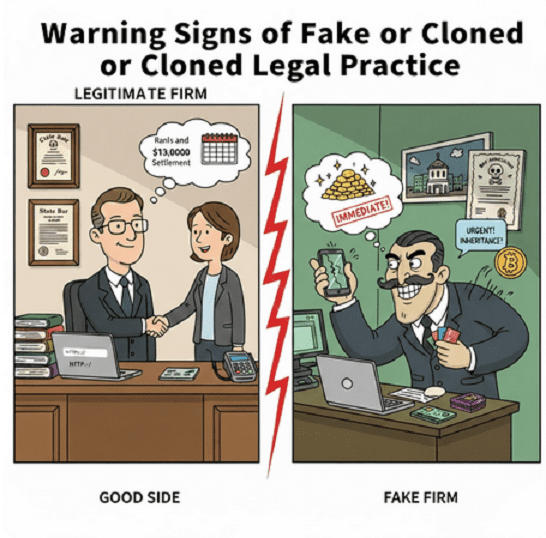
Warning Signs of a Fake or Cloned Legal Practice
Legal scams have become increasingly sophisticated. One of the most dangerous trends is the “cloned firm”—where scammers impersonate legitimate, well-known law firms or individual attorneys to steal sensitive information and money.
Here are the red flags you need to watch for in distinguishing a real legal professional from a predatory actor.
How to Verify a Law Firm
If you suspect you are being targeted by a cloned practice, take these steps immediately:
Independent Search: Do not click links in the email. Search for the firm’s name independently in a search engine.
Call the Main Line: Use the phone number listed on the official Bar Association website to call the firm and ask to speak with the person who contacted you.
Check the “S”: Ensure the website URL begins with
https://(the “s” stands for secure).
Important Note: If you believe you have been contacted by a scammer, report it to your local consumer protection agency or the State Bar.
1. Unsolicited Contact via Social Media or Messaging Apps
While some lawyers use LinkedIn for networking, most reputable firms will not initiate a client relationship via WhatsApp, Telegram, or Facebook Messenger.
The Red Flag: You receive an out-of-the-blue message claiming you are entitled to an inheritance, a settlement, or that you have an “urgent legal matter” pending.
The Reality: Legitimate firms usually contact clients through official mail or verified business email addresses after an initial inquiry.
2. Pressure to Pay via Non-Traditional Methods
Payment methods are one of the clearest indicators of a scam. Legal practices operate under strict financial regulations and must use secure, traceable banking channels.
| Legitimate Firms Accept: | Fake Firms Often Request: |
| Wire transfers to verified firm accounts | Cryptocurrency (Bitcoin, etc.) |
| Credit cards through secure portals | Prepaid gift cards (iTunes, Amazon) |
| Standard business checks | Wire transfers to personal names/Zelle |
3. Email Inconsistencies
Cloned firms often use email addresses that look almost identical to a real firm’s domain.
Check the Domain: If the real firm is
smithlaw.com, a scammer might usesmith-law-office.comorsmithlaw@gmail.com.Grammar and Formatting: While even pros make typos, persistent spelling errors or unprofessional formatting in a formal “legal notice” are major warning signs.
4. Lack of Physical Presence or Verified Credentials
A law firm without a verifiable physical office should be approached with extreme caution.
The Virtual Office Trap: Many scammers use “virtual” addresses or images of office buildings they don’t actually occupy.
Verify the Bar Association: Every practicing lawyer must be registered with their state or national Bar Association. If you cannot find the attorney’s name in the official directory, or if the contact information on the Bar website doesn’t match the person contacting you, stop all communication.
5. “Too Good to Be True” Promises
The law is rarely fast and never guaranteed.
The Red Flag: A firm guarantees a specific settlement amount or promises to “expedite” a complex legal process (like an immigration visa or a debt discharge) in an impossibly short timeframe.
The Reality: Ethical rules generally prohibit lawyers from guaranteeing specific outcomes.
Awareness is your strongest defense.
Contact us if you’d like more information on how cyber intelligence can help you locate scammers.
Please share this guide with friends and colleagues.
Cloned Firms Alerts & Scam Awareness

Topfin Holding topfinhold.com Clone of Luxembourg TOPFIN HOLDING S.A
Topfin Holding Clone of real Luxembourg TOPFIN HOLDING S.A

GlobalMarkets AC globalmarketsac.com Clone of Global Asset Advisors & Management S.A.
GlobalMarkets AC globalmarketsac.com The website impersonates Global Asset Advisors & Management S.A. Luxembourg

The Legal Reality – Are Clone Scammers Ever Caught?
A new breed of outlaw has emerged: the clone scammer. Whether they are using AI to mimic a CEO’s voice, deepfaking a relative’s face on a video call, or “cloning” credit cards and EBT data to drain accounts, these criminals feel untouchable behind their screens.

capitalether.com Capital Ether Clone of Real Luxembourg Company Ether Capital S.A.
capitalether.com Capital Ether Clone of Real Luxembourg Company Ether Capital S.A. as reported on CSSF financial authority.

Impersonation of Trive Financial Services Australia Pty Ltd pc.fairmarkets-fx.net
Impersonation of Trive Financial Services Australia Pty Ltd pc.fairmarkets-fx.net. Suspected Phishing website, reported by Moneysmart of Australia.

Impersonation of Finalto Australia Pty Ltd finaltoglobalau.com
Impersonation of Finalto Australia Pty Ltd finaltoglobalau.com alerted by Moneysmart of Australia.