
Why Scammers Prefer Cloned Firms Over Fake Company Names
Scammers prefer cloned firms over fake company names. Scammers realize that building a lie from scratch is a lot of work. Why spend months crafting a fictional brand, “Apex Global Wealth,” and hoping people trust it, when you can just move into the digital skin of “BlackRock” or “Vanguard” for the afternoon?
This is the era of the Cloned Firm—a sophisticated evolution of identity theft where fraudsters impersonate legitimate, regulated financial services businesses.
While fake company names still exist, they are increasingly being abandoned in favor of clones. Here is a deep dive into why scammers prefer the “stolen suit” of a real firm over the “imaginary friend” of a fake name.
1. The Weaponization of Pre-Existing Trust
The hardest part of any sale—legitimate or otherwise—is establishing trust.
When a scammer creates a fake company like “GoldStar Investments,” they start with zero brand equity. They have to convince the victim that the company is real, stable, and reputable. In contrast, a cloned firm piggybacks on decades of marketing, history, and consumer confidence.
The Halo Effect: If a victim sees the logo of a firm they recognize from the news or their local high street, their defensive walls drop.
The “Lindy Effect”: We tend to trust things that have been around a long time. Scammers “borrow” this longevity by claiming to be a branch or a specific broker from an established institution.
2. Cloned vs. Fake
Today’s consumers are savvy. If they receive a suspicious cold call, their first instinct is to search for the company on a regulatory database, such as the FCA (UK), SEC (USA), or ASIC (Australia).
The Fake Name Trap: If a user searches for “FakeWealth Inc.” on a regulatory register and finds nothing, the scam ends immediately.
The Clone Strategy: When the victim searches for the firm name provided by a cloner, they find a perfect match. They see a legitimate registration number, a real head office address, and a list of authorized activities.
The scammer simply claims, “Yes, that’s us! You can see we’re fully regulated on the government website.” By the time the victim realizes the contact details (phone number or email) don’t match the register, the money is usually gone.
3. Psychological “Cognitive Ease”
Human brains are wired to take shortcuts. This is known as Cognitive Ease. It is much easier for a victim to process a familiar name than a new one.
| Element | Fake Company Name | Cloned Firm |
| Brand Recognition | Zero. Requires heavy explanation. | High. Requires no introduction. |
| Initial Friction | High. Victim is naturally skeptical. | Low. Victim feels “safe” with a known brand. |
| Verification | Fails immediately on official sites. | Appears to pass official checks. |
| Email Credibility | support@wealth-123.com (Looks fishy) | claims@firmname-legal.com (Looks official) |
4. The Complexity of Modern Search Engines
Nowadays search algorithms prioritize Experience, Expertise, Authoritativeness, and Trustworthiness.
Creating a fake brand website that looks credible in search results takes significant time and money. However, a clone doesn’t need to rank. They use the cloned firm’s reputation to validate their presence. They often send victims direct links to the real firm’s history or “About Us” page while providing their own fraudulent payment portal via a separate, look-alike URL.
5. Exploiting the “Regulatory Gap”
Regulatory bodies are often slow to update their registers with “Warning Lists.” A scammer can clone a firm and operate for weeks or months before the real firm notices and reports the impersonation.
During this window, the scammer is effectively “cloaked” by the legitimate firm’s status. They use real employee names found on professional networking sites and real firm reference numbers to create an airtight facade of legality.
Key Tactic: Scammers often tell victims that the website listed on the regulator’s page is out of date or for “institutional clients only,” while the link they provide is for “new private retail investors.”
6. Higher “Ticket” Sizes and ROI
Scammers are, at their core, business-minded. They want the highest return on investment. People are rarely willing to wire $50,000 to a company they’ve never heard of. However, they are often willing to wire that same amount to a firm that looks exactly like a high-tier investment bank or a well-known insurance provider.
By using cloned identities, scammers can move away from “low-level” phishing and into High-Yield Investment Fraud, where the individual scores are significantly larger.
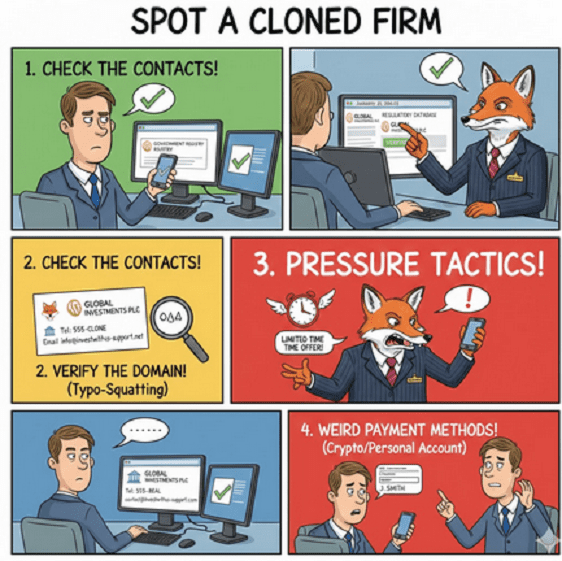
How to Spot a Cloned Firm
Even the most convincing clones have “seams” if you know where to look.
Check the Official Register: Do not use the phone number or email provided by the person contacting you. Search the official regulator’s website independently, find the firm, and use the contact info listed there to call them back.
Verify the Domain: Scammers use “typosquatting.” For example, if the real firm is
investwithus.com, the scammer might useinvest-with-us-legal.comorinvestwithus-support.net.Pressure Tactics: Legitimate firms rarely use high-pressure, “limited time” sales tactics via encrypted messaging apps like WhatsApp or Telegram.
Payment Methods: If a “reputable” firm asks you to deposit funds via cryptocurrency or into a personal bank account under an individual’s name, it is a clone.
Summary: The Path of Least Resistance
Scammers prefer cloned firms because it is the path of least resistance. It automates the trust-building process, provides a ready-made shield against basic due diligence, and allows for much larger thefts. In a world where information is everywhere, scammers have realized that the best way to hide is in plain sight, wearing someone else’s reputation.
Awareness is your strongest defense.
Contact us if you’d like more information on how cyber intelligence can help you locate scammers.
Please share this guide with friends and colleagues.
Cloned Firms Alerts & Scam Awareness

fernandogoldaracena90 Law Firm Clone per SRA of UK
fernandogoldaracena90@gmail.com law firm Clone of attorney at Latham & Watkins per SRA of UK.
Yuhua Tang clone of Law Firm Thornhill Legal Ltd
Yuhua Tang clone of Law Firm Thornhill Legal Ltd per SRA of UK Solicitors Regulation Authority
Fraudulent emails from emily@silverstonelaws.co.uk are impersonating a genuine law firm per SRA UK
Fraudulent emails from emily@silverstonelaws.co.uk are impersonating a genuine law firm per SRA UK Solicitors Regulation Authority

ironmarketltd.com Clone of FCA authorised firm
ironmarketltd.com Clone of FCA authorised firm
Capital Group (clone of FCA authorised firm)
Capital Group (clone of FCA authorised firm)

aurum-group.co aurum-group.info aurum-group.cc Clone of Aurum TM Limited
aurum-group.co aurum-group.info aurum-group.cc – Unauthorized Clone Website per FCA of UK, Financial Conduct Authority.
Get in touch today and receive a free phone consultation.
